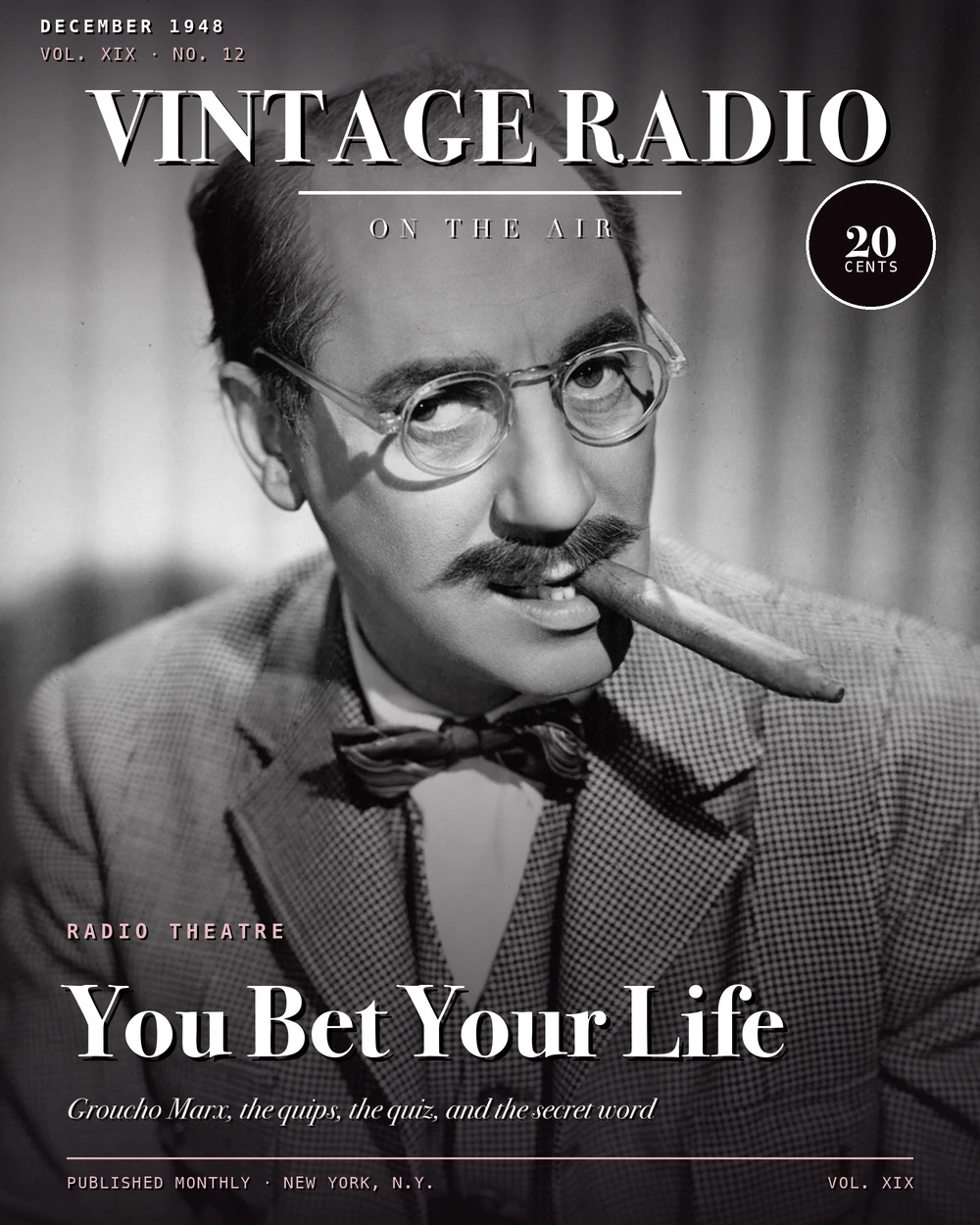
You Bet Your Life
How a Failed Radio Comedian Became Radio's Best
Before You Bet Your Life, Groucho Marx had tried radio four times. Four attempts, four failures — short runs, mediocre ratings, and a reputation that made some producers reluctant to book him even as a guest. The problem was simple: Groucho hated scripted material, and scripted material was what radio ran on. He was one of the funniest men alive, but the medium kept getting in his way.
The turnaround came in March 1947, when Groucho appeared on a radio program alongside Bob Hope. Groucho had been kept waiting forty minutes in the Green Room, and once on the air he ad-libbed his irritation about it, then kept ad-libbing for most of the rest of the broadcast. Producer John Guedel was listening. He approached Groucho afterward and asked whether he could ad-lib all the time. Marx answered that it was almost impossible for him not to. That was the opening Guedel needed.
Guedel had already put Art Linkletter on the game show charts with People Are Funny and House Party, and had suggested to Ozzie Nelson that his family might make good sitcom material — which eventually became The Adventures of Ozzie and Harriet. He had been trying to sell a quiz show concept, originally conceived as a weeknight quarter-hour with a traditional host asking audience contestants questions, but he hadn't been able to move it. He needed a personality. After hearing Groucho go off-script with Hope, Guedel figured he'd found one. As he later recalled: "I figured he'd be great working with people out of an audience. When people were being funny, Groucho could be the perfect straight man; when the people played it straight, Groucho couldn't miss with his own comedy."
In 1947, Guedel persuaded Marx to cut an audition record to help sell the show to clients. The press didn't exactly cheer when the deal was announced. Newsweek summarized the prevailing skepticism as being like "selling Citation to a glue factory." Groucho, after all, was a Marx Brother — a film comedian known for chaos and anarchic wit. A quiz show host? The reaction was disbelief. The show premiered on ABC on October 27, 1947, and proved everyone wrong — though not immediately.
Groucho's earlier radio history made the skepticism understandable. He had co-starred with Chico in the NBC Blue sitcom Beagle, Shyster & Beagle in 1932–33 (retitled Flywheel, Shyster & Flywheel when an actual attorney named Beagle threatened to sue). He had been a rotating panelist on The Circle in 1939. He had starred in Blue Ribbon Town on CBS from March 1943 to August 1944 with Virginia O'Brien, Leo Gorcey, and Fay McKenzie. A proposed sitcom called The Flotsam Family, written for him by Irving Brecher, couldn't find a sponsor because nobody could picture Groucho as a straight head-of-household — retooled for William Bendix, that script became The Life of Riley.
Getting the Format Right
The early programs were broadcast live, and there were difficult moments. Contestants froze. Groucho, without a script to fall back on, sometimes seemed to grope as well. The format — based on an old parlor game — had three couples onstage each episode to be interviewed and then quizzed. Each couple received $20 and bet as much as they dared on four questions from a category of their choosing, with money doubling on each correct answer for a maximum of $320. The couple with the most money at the end got a shot at a jackpot question that started at $1,000, with $500 added each week, sometimes reaching the $3,000 range. There was also a weekly "secret word": any contestant who said the word during the show collected a bonus ranging from $100 to $250 depending on the year.
The format was workable, but the live broadcast exposed every hesitation. Guedel solved it by recording sixty minutes of material on tape and editing it down to a twenty-six-minute package. Bing Crosby had already broken the network's ban against prerecorded material, which made the approach possible. The effect was dramatic. Within a year of going to tape, You Bet Your Life leaped from 92nd in the Hooper ratings into the top ten. By the 1948–49 season, even during its ABC period, the show had climbed to a 12.1 rating and 46th place — solid progress from dead last. Groucho won the Peabody Award for the 1947–48 season, presented April 21, 1949, with the citation describing him as "the only man on the air who can work without a script and bat off a brilliant succession of witticisms."
The money involved was modest by modern standards, but the show's philosophy kept anyone from going home empty-handed. If a couple lost everything, Groucho asked a consolation question worth $25 — frequently "Who was buried in Grant's tomb?" — with the assurance that "nobody leaves here broke." Groucho and Guedel were co-owners of the show, and they paid secret word winners out of their own pockets in cash on the spot. The sponsor covered the larger prizes. Groucho himself was paid $3,000 a week to host.
The format kept evolving. From 1947 to 1953, couples started with $20 and wagered per question. From 1953 to 1954, after co-director Robert Dwan observed that too many couples were betting and losing most of their money, the format shifted so couples started with nothing and selected question values from $10 to $100. From 1954 to 1956, couples started with $100 and incorrect answers halved their bankroll. Later seasons adjusted the number of couples and the question structure again. The game was always secondary to the conversation, but the producers kept trying to make the quiz portion feel fair.
The Art of Picking the Right Contestants
The machinery behind the show was more elaborate than it looked. A staff of thirteen people scanned newspapers, monitored neighborhoods, and read letters looking for colorful personalities. About two hundred prospective contestants turned up each week. Twenty were interviewed by the staff. Six were chosen for broadcast. Producers would sometimes invite a group from a single occupation — plumbers, say — to the broadcast, interview them in a pre-show warmup, and let the studio audience pick who actually went on the air.
Co-director Bernie Smith laid out the show's operating principle plainly: "The idea is to find a remarkable personality and let Groucho throw rocks at him." Elsewhere Smith put the casting philosophy this way: "We've got to have people who have something to say and will say it. If they're characters, so much the better." The ideal pairing was articulate, uninhibited, and mismatched — a bachelor with a spinster, a mother-in-law with a son-in-law, a traffic cop with a woman driver. Contestants were not paired until the night of the broadcast, and each pair was kept offstage and out of hearing while others played.
Groucho never met contestants before they appeared in front of him with the tape rolling. In staff meetings he was told only their occupations, and occasionally that someone had an unusual background. That ignorance was deliberate. The freshness of Groucho's reactions — the genuine curiosity and the genuine impatience — depended on him not knowing what was coming. He hated "smart-alecks" who arrived with pre-planned cute routines, and he had ways of making them regret it. George Eels wrote in Look magazine that Marx had discovered "that if he needles people, he'll keep them on their toes." He asked car salesmen how many times they'd been indicted. He put the same kind of pointed questions to mayors and politicians. One contestant wrote afterward: "The money really did not matter. I just wondered if I dared talk to Groucho."
Not everyone came off second-best. An eighty-year-old female contestant threatened to walk off unless Groucho put out his cigar. He stamped it out immediately and said nothing more about it. Eels offered three possible explanations: genuine respect for age, awareness that audiences enjoyed seeing him squelched, and the possibility that he simply couldn't think of a comeback. Groucho was also known to make occasional remarks on air advocating racial tolerance or international understanding — brief, but there.
Groucho, Fenneman, and the People Around the Show
George Fenneman came into the show in 1947 after director Bob Dwan spotted him at Hollywood and Vine during lunch and sent him immediately to an audition. Fenneman, born November 10, 1919, in Peking to American parents and raised in San Francisco, had a B.A. in Speech and Drama from San Francisco State College. He had spent part of World War II working as a broadcast correspondent for the U.S. Office of War Information after being rejected for military service due to poor eyesight and asthma; it was there he first met Jack Webb, who would later hire him for Dragnet. He started at You Bet Your Life for $55 a week.
The job description was unusual. Fenneman was described as a "super-straight mikeman with a keen sense of humor" whom Groucho constantly bullied — and the bullying was part of the act. On the closed circuit, Fenneman's voice informed contestants how much money others had won and what the secret word was. He also tracked contestant earnings through the broadcast, which could get complicated when contestants bet amounts like "twelve dollars and forty-seven cents." His salary eventually grew to more than $50,000 a year, and he purchased a ten percent interest in the production company, taking a percentage of gross revenues rather than standard residuals. He stayed with the show — radio and television — for twelve years. In 1956 he won Best Announcer from the Television Critics of the United States, and he received a star on the Hollywood Walk of Fame in 1981. Beyond You Bet Your Life, he announced on The Orson Welles Show, Pat Novak For Hire, The Dean Martin and Jerry Lewis Comedy Show, the radio version of Gunsmoke, and others.
Before Fenneman, Mike Wallace had announced the show during the Elgin-American sponsorship period, with Jack Slattery briefly in the chair before him. Music came from a ten-piece orchestra led by Billy May, later replaced by Jack Meakin and then Jerry Fielding. Writers Ed Tyler and Hy Freedman kept whatever preparation the show required — which was not much — in order.
John Guedel created, produced, and directed the show alongside Bernie Smith and Bob Dwan. The theme was "Hooray for Captain Spaulding," composed by Bert Kalmar and Harry Ruby for the Marx Brothers film Animal Crackers. When the announcer called it a "comedy-quiz show," the "comedy" designation was considered meaningful, not incidental.
The HUAC Trouble and the Political Undercurrent
In December 1953, musical director Jerry Fielding — born Joshua Itzhak Feldman on June 17, 1922 — was called to testify before the House Un-American Activities Committee. He invoked the Fifth Amendment and refused to name names. DeSoto-Plymouth Dealers of America then demanded he be fired. He was. Fielding later said that HUAC had called him because they wanted him to name Groucho as a Communist sympathizer.
That same year, the FBI opened a formal Internal Security investigation of Groucho Marx based on a confidential informant's tip. Historian Jon Wiener of UC Irvine later obtained the files through the Freedom of Information Act and described them in detail. The FBI ultimately concluded that Groucho was not a Communist Party member.
The irony, in retrospect, is that Fielding went on to become one of Hollywood's most distinguished film composers. He received three Academy Award nominations — for The Wild Bunch in 1969, The Outlaw Josey Wales in 1976, and Escape from Alcatraz in 1979. He had been blacklisted following the HUAC episode and did not resume mainstream Hollywood composing until 1962.
Network Moves and the Television Overlap
You Bet Your Life moved from ABC to CBS on October 5, 1949, where it ran Wednesdays at 9 PM through June 28, 1950. Elgin-American — whose president Allen Gellman had sponsored Groucho through the first two and a half seasons selling watch cases, bracelets, compacts, cigarette cases, and dresser sets — continued through early January, when DeSoto-Plymouth took over. The show moved to NBC on October 4, 1950, where it stayed until the radio finale on September 19, 1956. DeSoto-Plymouth sponsored the NBC run throughout, and each show ended with Groucho sticking his head through a hole in the DeSoto logo: "Friends...go in to see your DeSoto-Plymouth dealer tomorrow. And when you do, tell 'em Groucho sent you."
From October 1950 onward, the show ran simultaneously on radio and NBC television, though not at the same moment — the simple format made dual production practical. The television version had its own character. Many of the laughs there came from Groucho's facial reactions and visual gimmicks that didn't translate to audio. On television, when a contestant said the secret word, a toy duck — rigged out with eyeglasses, a mustache, and a cigar in its bill — descended from the ceiling carrying a $100 prize. On one episode, Harpo Marx came down in place of the duck. By 1953, the television version was the number-three-rated show on American television. Groucho had won an Emmy in 1950 as the most outstanding personality on television.
The show was also the first network television series to run summer reruns instead of a replacement show, beginning in 1952 with thirteen episodes from each prior season rebroadcast under the title The Best of Groucho. It was the first game show to have its reruns syndicated.
Notable guests and future celebrities appeared as contestants over the years: Phyllis Diller in her first television appearance, Ray Bradbury, Jack LaLanne, Rocky Marciano, Don Drysdale, Joe Louis, Candice Bergen at age eleven and a half, and Harland Sanders talking about his "finger-lickin'" fried chicken recipe. William Peter Blatty appeared in disguise as an Arabian prince. The show was parodied in a live April 1955 episode of The Jack Benny Program, with Benny disguising himself as a contestant and repeatedly trying to say the secret word while Groucho quizzed him about his own real age.
In 1973, during a party at his home, Groucho received a call from an NBC warehouse employee reporting that the network was discarding You Bet Your Life film prints. NBC offered the reels to Marx at no cost. Producer Guedel had already made his own royalty deal with NBC to syndicate the old episodes — unlike most pre-1973 NBC productions, the show had been excluded from the package sold to National Telefilm Associates. NBC retained ancillary rights and NBC Enterprises handled distribution from 2001 to 2004. Two DVD collections followed: You Bet Your Life: The Lost Episodes in 2003, with eighteen classic episodes and bonus outtakes including original sponsor mentions, and You Bet Your Life: The Best Episodes in 2004, with another eighteen episodes and three game show pilots featuring Groucho. Both were released by Shout! Factory and Sony Music Entertainment, presented uncut and remastered from original kinescopes. More than two hundred episodes of the radio show exist on tape, with some one-hour uncut recordings — the raw material edited down to twenty-six-minute broadcasts — surviving mostly from spring 1949 and fall 1953.
After the Run
The radio version ended September 19, 1956. Television continued through a final season beginning September 22, 1960, under the new title The Groucho Show, before ending in 1961. Seven months after the NBC run concluded, Groucho hosted a follow-up game show on CBS called Tell It to Groucho, which aired through spring 1962 and featured two teenaged sidekicks, Jackson Wheeler and Joy Harmon, both of whom had appeared as contestants during You Bet Your Life's final season.
The show has been revived three times since. Buddy Hackett hosted a syndicated version from 1980 to 1981, produced by Hill-Eubanks Productions, with Ron Husmann announcing. Bill Cosby hosted a Carsey-Werner syndicated version from September 1992 to June 1993, taped at WHYY-TV in Philadelphia, with Robbi Chong as a sidekick billed as "Renfield" and a black goose in a Temple University sweatshirt filling the secret-word role. Richard Dawson had shot an NBC pilot on August 3, 1988, but it was never picked up. Jay Leno launched a Fox First Run revival on September 13, 2021, with Kevin Eubanks — his longtime Tonight Show bandleader — as co-host and theme song composer. The show was renewed for a second season but was canceled in August 2023 when Leno, a WGA member, halted production in solidarity with striking writers.
You Bet Your Life was inducted into the Radio Hall of Fame in 1988. Groucho died on August 19, 1977; Fenneman followed twenty years later, on May 29, 1997, in Los Angeles, at 77.